
Padel vs Tennis: Rules, Difficulty and Cost Compared
Guides
Choose by playing style, social format and true booking cost—not assumptions.
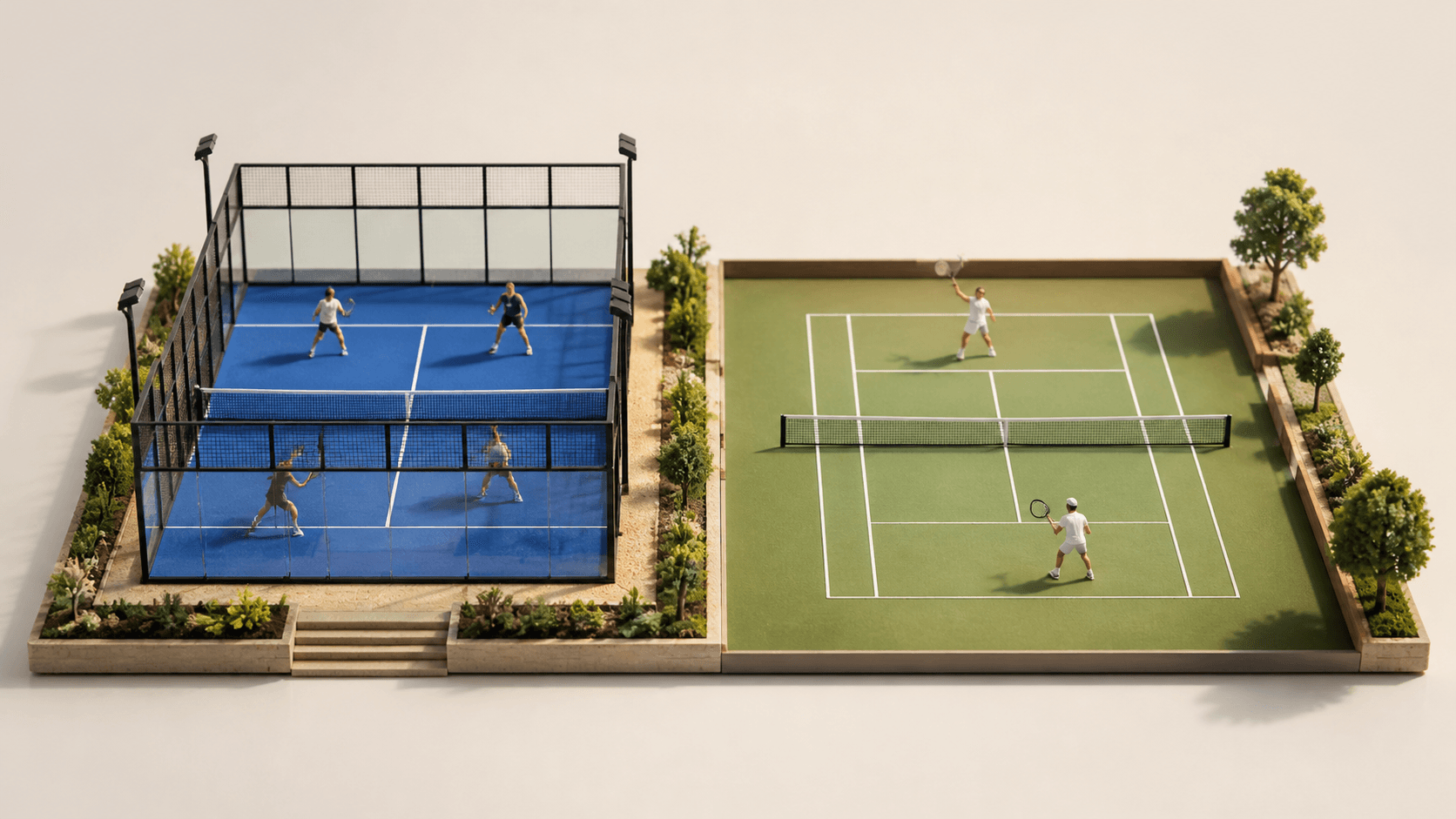
What is the difference between padel and tennis, and which should I choose?
Padel is usually doubles on a 20 × 10 metre enclosed court, with an underarm serve and walls that remain in play. Tennis uses a larger open court, an overhead serve and singles or doubles. Padel often produces an earlier beginner rally, while glass reading, net position and team tactics add long-term depth.
Key takeaways
- A padel court is 20 × 10 metres and enclosed.
- Tennis supports singles and doubles; padel is predominantly doubles.
- Padel may create a social rally sooner for beginners.
- Compare price per player and minute, not the headline court fee.
Quick answer
- 01Padel uses a smaller court enclosed by glass and mesh.
- 02Padel is usually played by four people; tennis by two or four.
- 03Padel serves underarm; tennis serves overhead.
- 04The cheaper option depends on local price and player count.
The defining difference
The sports share a scoring language and many racket skills, but the rally geometry is different. In padel, a ball can bounce on court, rebound from the glass and remain live. In tennis, surfaces beyond the lines are not part of play. That difference transforms positioning and decision time.
Court size and player count
FIP rules define a padel court as 20 metres long and 10 metres wide, divided by a net and enclosed by playable walls. Under ITF rules, a tennis court is 23.77 metres long and 8.23 metres wide for singles or 10.97 metres for doubles.
Read the official FIP rules for padel dimensions and wall play.
See the ITF Rules of Tennis for official tennis-court dimensions.
Rules and equipment
Serve
In padel, the server bounces the ball and strikes it below waist height into the diagonal service box. Tennis begins with an overhead serve struck from the air. Both sports allow a first and second serve.
Racket and ball
A padel racket is short, stringless and perforated. A tennis racket has strings and a longer handle. The balls look similar but official pressure and rebound ranges differ, so use the intended ball.
Scoring
Traditional game scoring is familiar: 15, 30, 40 and game. FIP introduced the Star Point option on professional circuits in 2026 for play after deuce; always check the format published by your club or event.
FIP’s official explanation of the 2026 Star Point system.
Which is easier to start?
Padel’s underarm serve, smaller space and four-player format can make the first rally easier to establish. Tennis asks beginners to cover more space, learn an overhead serve and, in singles, reach every ball. That does not make advanced padel easy: reading glass and protecting the net as a pair has a long learning curve.
Physical pace and feel
Singles tennis often involves longer running distances and changes of direction in open space. Padel produces shorter bursts, frequent low turns, quick reactions and synchronised movement with a partner. If you have a health condition or injury, seek appropriate professional advice on intensity.
How to compare cost
Do not compare only the hourly sticker price. Padel is normally divided among four players; tennis can be split between two in singles or four in doubles. Add court, rental, balls and travel, then divide by player count and actual minutes played.
Moving from tennis to padel
- Compact volleys and early preparation transfer well.
- Shorten large tennis swings because reaction time is smaller.
- Leave room for the ball to rebound from the glass.
- Do not attack every ball; first earn net position.
- Move forward and back together with your partner.
Which one suits you?
Choose padel if you want a social, team-based game that starts quickly. Choose tennis if you value singles freedom, more open space and a serve-led technical journey. The best test is one beginner session in each, then notice which learning process makes you want to return.