
What Is Padel? Rules, Court and Scoring Explained
Guides
A complete introduction for anyone researching padel for the first time.
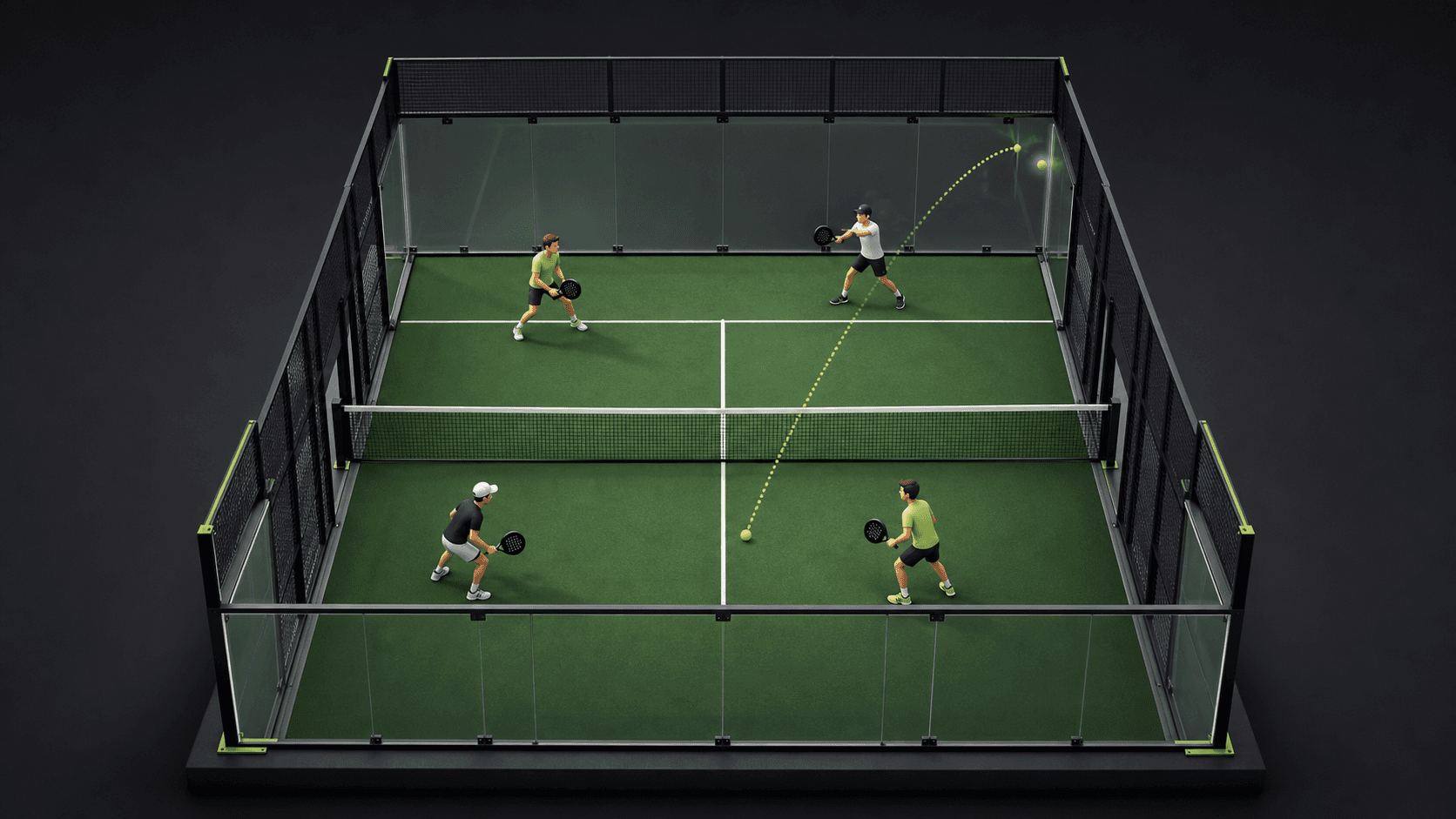
What is padel and what are its basic rules?
Padel is usually played two against two on a 10-by-20-metre enclosed court divided by a net. The serve is hit diagonally at or below waist height after a bounce. During a rally, the ball may rebound from the walls after first touching the opponent’s floor and must be returned before its second bounce.
Key takeaways
- Standard padel is played by two teams of two.
- The official court measures 10 by 20 metres.
- The serve is hit diagonally at or below waist height.
- Walls enter play after the ball bounces on the court.
- Scoring follows the 15, 30, 40, and game sequence.
- Deuce may use advantage, Star Point, or Golden Point.
Padel is a racket sport usually played by two teams of two on an enclosed 10-by-20-metre court divided by a net. Players use solid perforated rackets, and the serve is struck at or below waist height after the ball bounces. What makes padel distinctive is that the glass walls and metal fencing can become part of the rally after the ball first bounces correctly on the court.
What is padel?
Padel combines tennis-style scoring, doubles teamwork, and rallies that use the surrounding walls. The court is smaller than a tennis court and is enclosed by glass or solid walls and metal fencing. After the ball bounces correctly in the opponent’s court, it may rebound from these surfaces and must be returned before its second bounce.
The basic objective is to send the ball into the opponent’s court legally and prevent a valid return. Power can help, but positioning, lobs, patience, and communication with a partner are central to the sport.
When and where was padel invented?
According to the International Padel Federation’s history, the sport began in 1969 at Enrique Corcuera’s home in Acapulco, Mexico. Without enough space for a full tennis court, he created a smaller 20-by-10-metre court enclosed by walls. Padel reached Spain and Argentina in the early 1970s and later developed into an international sport.
What does a padel court look like?
An official padel court measures 10 metres wide by 20 metres long internally. A net divides it in half. Each side includes service lines and a central line that divides the area into right and left service boxes.
The court is fully enclosed. The ends use glass or another hard, smooth surface, while the sides may combine glass and metal fencing. The walls are not merely boundaries; they can be used during a rally after the ball has bounced on the floor.
What is the difference between padel and tennis?
- A padel court measures 10 by 20 metres and is enclosed by walls.
- Padel uses a solid, perforated racket without strings.
- The serve is struck at or below waist height after a floor bounce.
- The ball may rebound from glass and fencing after first touching the court.
- Standard padel is played by two teams of two.
- The scoring resembles tennis, although the deciding format after deuce may vary.
How is padel played?
- A point starts when the server bounces the ball behind the service line and sends it into the diagonal service box.
- The receiver allows the serve to bounce in the service box and returns it before the second bounce.
- During the rally, the pairs hit the ball alternately. The ball may touch the walls after bouncing in the opponent’s court.
- The point ends when the ball bounces twice, fails to cross the net, or reaches a surface in an invalid order.
- Teams collect games to win sets and the match.
The basic padel serve rules
- The server stands behind the service line.
- The ball must first bounce in the server’s service area.
- Contact must be at or below waist height, with at least one foot touching the ground.
- The serve must land in the diagonal service box.
- A player receives a second attempt after a first-service fault.
- A valid serve must bounce in the service box before the receiver returns it.
How do the walls work in padel?
The walls are the rule most likely to confuse first-time viewers. The simple principle is that a shot sent to the opponents must touch their floor before reaching their wall or fencing. Once the ball has bounced on the floor, it can rebound from the enclosure and remain in play until its second floor bounce.
Players may also use their own glass to return a ball. The shot can rebound from the wall on the player’s side and travel over the net, provided it then lands on the opponent’s floor before reaching their enclosure.
When is a point lost?
- The ball bounces twice before being returned.
- The shot fails to cross the net.
- The ball hits the opponent’s wall or fencing before touching their floor.
- The ball touches a player, their partner, or something they are wearing instead of the racket.
- A player, racket, or carried item touches the net while the ball is in play.
- The same pair hits the ball twice or the server commits two consecutive faults.
How does padel scoring work?
The basic point sequence is 15, 30, 40, and game. Under the traditional advantage format, 40-40 is deuce and a pair must win two consecutive points to take the game. A set is normally won by reaching six games with a two-game margin. At 6-6, a tie-break is played, and official matches are generally the best of three sets.
The current FIP rules provide advantage, Star Point, and Golden Point options for games that reach deuce. Always confirm which system applies before a club match or tournament begins.
What equipment do you need for padel?
Padel racket
A padel racket has no strings. Its hitting surface is solid, flat, and perforated. The official rules require the safety cord attached to the handle to be worn around the wrist.
Padel ball
A padel ball resembles a tennis ball but has pressure and bounce specifications approved for the sport. Use balls designed specifically for padel.
Shoes and clothing
Choose shoes that support lateral movement and provide suitable grip for the court surface. Comfortable sportswear and water are enough for a basic first-match setup.
Common padel terms
- Lob: A high shot intended to travel over the opponents and push them towards the back of the court.
- Volley: A shot played before the ball bounces, usually close to the net.
- Bandeja: A controlled overhead used to maintain net position after an opponent’s lob.
- Víbora: A more aggressive overhead played with side spin and additional pace.
- Chiquita: A controlled, slower ball directed towards the opponents’ feet.
- Tie-break: The deciding game used when a set reaches 6-6.
What should you do after learning the rules?
To prepare for your first court session and learn positioning and beginner tactics, continue with How to Play Padel: A Beginner’s Guide.
When you are ready, use BiKort to discover nearby padel venues, available times, and booking options.